Bitcoin, Tech and Crypto Meets Longevity: Capital’s Shared Bet on Time
At first glance, Bitcoin and longevity appear to belong to entirely different worlds.
Bitcoin emerged as a decentralized monetary network designed to preserve value across time. Longevity is an emerging sector spanning aging research, preventive medicine, diagnostics, supplements, and health optimization, all focused on extending healthy human lifespan.
Yet an increasing overlap between these ecosystems is becoming visible.
A number of founders and investors who helped build the cryptocurrency economy are now funding longevity research, supporting health optimization initiatives, and investing in companies working to slow or reverse biological aging.
The convergence is not accidental.
Both movements revolve around a similar underlying question:
How much control humans can exert over time?
Bitcoin attempts to protect financial value from erosion across decades.
Longevity seeks to preserve biological function across decades.
For a growing group of investors, both represent attempts to challenge systems once assumed to decline inevitably.
A Shared Ethos: Rejecting the “Inevitable”
Inflation slowly erodes the purchasing power of money.
Aging slowly erodes the resilience of the human body.
Both processes unfold gradually, compounding across time.
For most of history, both were accepted as structural realities rather than solvable problems.
Bitcoin challenged that assumption in finance.
Longevity is beginning to challenge it in biology.
Researchers increasingly view aging not simply as a natural process but as a biological system driven by cellular damage, metabolic regulation, and genetic pathways that may be measurable and eventually modifiable.
For investors used to thinking in long time horizons, the analogy becomes clear.
Inflation ≈ Aging

Both financial systems and biological systems experience a similar form of long-term degradation.
In finance, inflation gradually reduces the value of currency.
In biology, aging gradually reduces physiological performance.
Both are examples of entropy acting across time.
Bitcoin attempts to counter financial entropy by enforcing scarcity and decentralization.
Longevity research attempts to counter biological entropy through cellular repair, metabolic optimization, and preventative medicine.
This conceptual overlap explains why many technologists and crypto investors have become interested in longevity.
Tech and Crypto Capital Finds Longevity
One of the clearest signals of the connection between these sectors is capital allocation.
Several founders and investors associated with the cryptocurrency ecosystem are already directing funding toward longevity.
Examples include:
Brian Armstrong – Coinbase
Armstrong co-founded NewLimit, a biotechnology company researching epigenetic reprogramming aimed at restoring youthful gene expression in human cells.
Vitalik Buterin – Ethereum
Buterin has donated millions to aging research initiatives including the SENS Research Foundation, one of the earliest organizations focused on repairing cellular damage associated with aging.
Justin Sun – TRON
Sun pledged $51 million toward a longevity prize designed to accelerate breakthroughs in life-extension research.
Charles Hoskinson – Cardano
Hoskinson announced plans to invest approximately $100 million into a longevity clinic and research facility focused on preventative medicine and lifespan extension.
Arthur Hayes – BitMEX
Hayes has invested in companies working on stem-cell biotechnology and regenerative medicine.
Beyond the crypto ecosystem itself, several technology investors are also funding longevity companies:
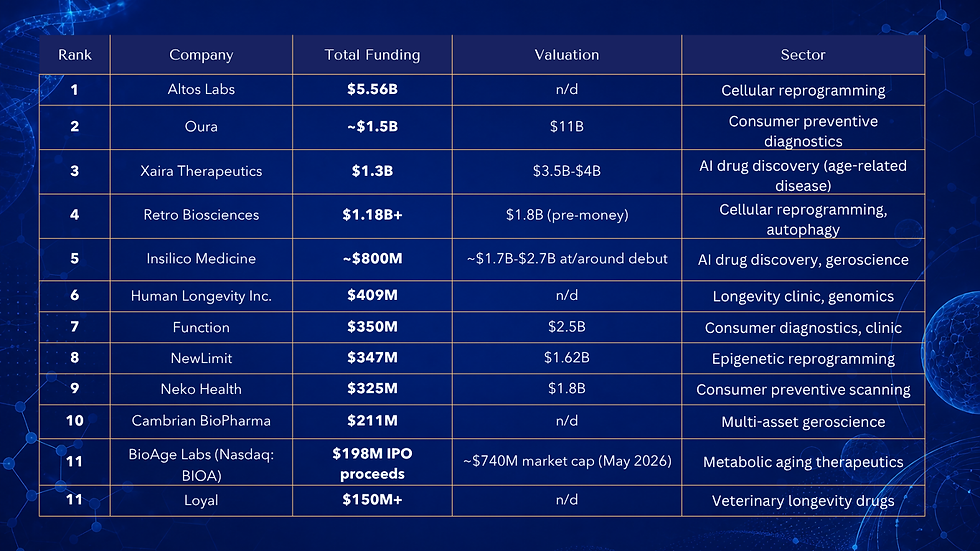
Jeff Bezos – investor in Altos Labs, researching cellular reprogramming (they raised $3 billion so far)
Sam Altman – backing Retro Biosciences, funded with roughly $180 million
Brian Armstrong – through NewLimit, targeting epigenetic rejuvenation
These investments suggest a broader trend: capital created in frontier technologies increasingly flows toward longevity.

Longevity Infrastructure Meets Crypto Infrastructure
The convergence is not limited to investors.
New infrastructure is also emerging at the intersection of crypto and longevity.
Decentralized science platforms such as Molecule and VitaDAO are experimenting with new ways to fund and coordinate biomedical research.
These models use blockchain systems to:
fund scientific research
distribute intellectual property ownership
enable global collaboration between researchers and investors
The idea is simple but powerful:
Use decentralized networks to accelerate scientific discovery.
In this sense, crypto infrastructure may become an unexpected catalyst for longevity research.

Outlook: Biology Becomes the Next Frontier
Longevity remains an early-stage sector relative to its potential scale.
But the forces driving its growth are already visible.
Global populations are aging rapidly. By 2050 the number of people aged 65 and older is expected to double, placing enormous pressure on healthcare systems and economic productivity.
At the same time, advances in aging biology - including cellular reprogramming, biomarker diagnostics, and regenerative medicine - are transforming aging from an abstract concept into a measurable biological process.
For investors accustomed to identifying transformative technologies early, the pattern may look familiar.
Bitcoin challenged the architecture of financial systems.
Longevity may ultimately challenge the architecture of biological aging.
Both revolutions are rooted in the same ambition:
Extending human agency across time.
The ideas explored in this article build on insights shared by Marc P. Bernegger, Founding Partner of Maximon and Longevity Investors, during his talk at the Plan ₿ Forum in Lugano (October 2025).
In the presentation, Bernegger examined the emerging intersection between Bitcoin, frontier technology capital, and longevity science, highlighting how capital created in the crypto ecosystem is increasingly flowing into research aimed at extending human healthspan. The talk and its themes were also covered in Maximon’s event recap:
Watch the full talk:
Speaker profile:
Event highlight:
Sources
[1] https://www.thestreet.com/crypto/markets/billionaire-whos-fighting-death-makes-a-shocking-new-claim
[2] https://cointelegraph.com/news/longevity-expert-explains-link-between-crypto-community-anti-aging
[10] World Health Organization — Global Health and Aging Report
[11] López-Otín et al. — The Hallmarks of Aging, Cell (Nature/Cell research)


Mình mua vé số chủ yếu cho vui, kiểu có chút hồi hộp cuối ngày, trúng thì coi như thêm niềm vui, không trúng cũng chẳng áp lực gì. Trước đây nghe bạn bè bàn chuyện “cầu” với “kèo” rôm rả nên mình cũng thử tìm hiểu, mà mới đầu thấy loạn hết cả lên. Sau một thời gian theo dõi, mình bắt đầu ghi lại vài nhận định mình đọc được để tự kiểm tra xem có phải mình đang tự tưởng tượng quy luật không. Thỉnh thoảng mình ghé soicauxsmb.io để có thêm chuyện tám với tụi bạn, nhưng luôn tự nhắc là chỉ tham khảo thôi. Có hôm trúng chút đỉnh thì vui, có hôm lệch xa…
Mình thường coi dự đoán miền Bắc như một kiểu giải trí nhẹ nhàng, đọc xong rồi tự đối chiếu xem suy nghĩ của mình có trùng không. Hồi trước toàn chọn theo linh cảm, nhưng càng theo dõi càng thấy dễ bị mấy dãy số “nhìn hợp mắt” dẫn dắt nếu không có chút thống kê hay lý do đi kèm. Gần đây mình hay lướt du doan mb ở vài chỗ khác nhau, rồi tự lọc lại theo cách riêng, thích những nhận xét có giải thích hơn là chỉ đưa số. Trúng thì vui thật, nhưng mình luôn nhắc bản thân đây vẫn là hên xui, đừng đặt kỳ vọng quá kẻo mất vui. Đọc bình luận…