The AI Longevity Drug Race: Where 2026 Capital Is Running Ahead of the Science

18 months to a drug candidate. Years to know if it works. Billions are being invested in the gap.
AI can now design a drug candidate in around eighteen months, a step that used to take years. What it cannot do is shorten the years of clinical trials that follow, or the longer wait to know whether a drug actually works. AI made the cheaper, early part of drug development fast and left the expensive, decisive part almost untouched. That is the half that decides whether any of this pays, and right now capital is arriving as though the whole problem were already solved.

What AI Compressed, and What It Did Not
AI can now do three things dramatically faster than traditional drug-discovery workflows: it reads biological data to nominate which target to drug, designs candidate molecules instead of screening thousands by hand, and compresses the months of chemistry in between. Insilico Medicine's headline result makes the scale concrete: target to drug candidate in as fast as 18 months, testing just 78 molecules where the old approach could mean thousands.
That is the good news, and it is where the good news stops.
The moment a drug reaches the efficacy test, the apparent AI advantage narrows dramatically. The largest analysis to date found AI-discovered drugs clear the first, safety-focused stage of trials at an 80 to 90 percent rate, far above the industry's historic 52 percent. But at the next stage, the one that asks whether the drug actually works, AI-discovered drugs succeed about 40 percent of the time, roughly in line with conventional drug-development benchmarks.
AI has shown it can quickly design drug-like molecules that perform unusually well in early safety testing. It has not yet shown that those molecules are more likely to work in patients. For longevity, where the biology is the hardest in medicine, that distinction is the whole game.

The AI Longevity Field: Insilico, Retro, NewLimit, BioAge and Gero
Insilico Medicine is the company that got furthest, by a distance. Its lead drug, rentosertib, is the first in which AI both chose the target and designed the molecule and which has then been tested in people. The indication is idiopathic pulmonary fibrosis, an age-related scarring of the lungs, the classic longevity move of entering through a specific age-related disease. In a Phase 2a trial of 71 patients published in Nature Medicine in June 2025, the highest-dose group showed a mean 98.4 mL increase in lung function (FVC), versus a 20.3 mL decline on placebo over twelve weeks. FVC was a secondary endpoint; the trial was designed primarily to assess safety, making this an encouraging signal rather than proof of efficacy, and no claim on aging itself. A larger China trial is due to start in late 2026.
The business signal was louder than the clinical one. Insilico listed in Hong Kong in December 2025, raising roughly $293M, with the public tranche oversubscribed about 1,427 times. In March 2026 it signed with Eli Lilly for up to $2.75B, of which only $115M is committed upfront and the rest is milestone money. Its president, Dr. Alex Aliper, runs the AI platforms behind all of it. Rentosertib is a genuine case where AI both selected the target and designed the molecule, not merely assisted a human team. Garri Zmudze of LongeVC, one of Insilico's earliest backers, joins LIC 2026 in Gstaad.
Retro Biosciences is the reprogramming bet with an OpenAI twist. Launched with $180M funded personally by Sam Altman, Retro worked with OpenAI on a model that redesigned the Yamanaka cell-rejuvenation proteins, producing more than 50-fold higher expression of stem-cell reprogramming markers in vitro than the standard proteins. That last phrase matters: it is a laboratory result, not a human one. Retro has separately dosed its first patient in a Phase 1 Alzheimer's trial.
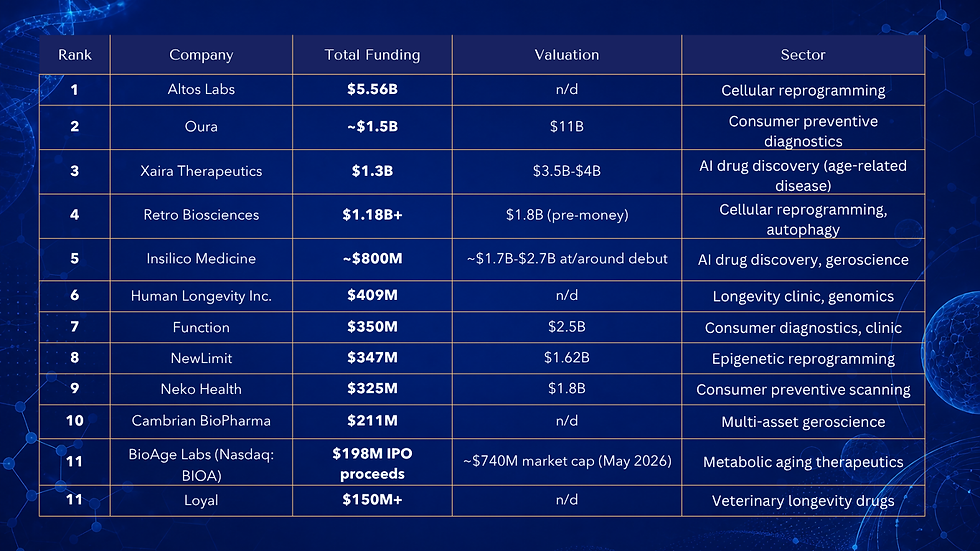
NewLimit is the purest age-reversal play on the board, and the clearest example of the whole thesis. Co-founded by Coinbase's Brian Armstrong, it uses machine learning to guide cellular reprogramming. In June 2026 it raised a $435M Series C led by Founders Fund at a $3.1B valuation, roughly triple its worth a year earlier, with Eli Lilly Ventures on the cap table. It has no product, no revenue, and has not yet begun a human trial; its first, targeting alcohol-related liver disease, is planned for 2027. A three-fold valuation step in twelve months for a preclinical company is exactly what capital running ahead of proof looks like.
BioAge Labs is the one you can actually buy. Nasdaq-listed, targeting the biology of metabolic aging, with its lead NLRP3 inhibitor already in human testing. BioAge ended 2025 with $285M in cash and marketable securities and completed a further $132.3M follow-on offering in early 2026, giving it runway into 2029. For allocators who want liquid, public longevity exposure, the options are few and this is one.
Gero is the wildcard, and the one chasing aging most directly. Its AI, built on the physics of aging, picked 22 compounds; 16 extended lifespan in worms, one by 74 percent. Worms are a long way from people, so read it as early science with a Chugai Pharmaceutical collaboration worth up to $250M in milestones, on just $34M raised. Gero presented at LIC 2025 and returns to Gstaad for LIC 2026.
Two names sit in the "watch, but not longevity yet" column. Isomorphic Labs, the DeepMind spinout behind AlphaFold, raised $600M and expects AI-designed drugs in trials by end-2026, but its focus is cancer and immunology. Recursion has flirted with aging and moved on to oncology.

The Catch: No Approvable Target, No Proven Drug
There is still no established regulatory indication for "aging itself." Longevity companies therefore generally enter the clinic through recognised diseases and accepted endpoints: fibrosis, Alzheimer's, metabolic disease and cardiovascular risk. The long-running TAME trial was designed in part to test whether a multi-disease aging endpoint could establish a regulatory framework for geroscience, a framework it has not yet delivered.
AI has not compressed the slow part by anything like the same degree. Candidate discovery can now happen in months; clinical trials still run for years, and a genuine healthspan readout could take longer still. The clinic remains the bottleneck.
And nothing has crossed the line. As of mid-2026, no AI-discovered drug of any kind has been approved anywhere, and none has been shown to slow aging in a human. One 2026 tally counted 117 AI-linked drugs in human trials across 63 companies, of which only 8 had cleared Phase 2, though counts range higher depending on how "AI-discovered" is defined and which tracker is used. The word "AI-discovered" is also doing a lot of marketing work: insist on the difference between a drug AI genuinely designed and one it merely assisted.
What Investors Are Actually Buying
What AI has genuinely de-risked is the chemistry, not the biology. It compresses the cost and time to a credible candidate and sharpens the logic behind the target. That is real and it compounds: more shots on goal per dollar, cheaper failures. What it has not de-risked is whether any given molecule works in a human, or whether hitting an aging mechanism delivers more healthy years. That remains fundamentally a biology bet.
Yet the money is front-running the proof. Longevity biotech raised roughly $3.74B across 49 financings in the first quarter of 2026, up 56 percent year on year. That is the trade in a single statistic: capital is ahead of the clinical evidence, and investors are being asked to underwrite the gap.

Questions to be answered
The field can now find drug candidates fast. What it cannot yet do is prove, at biology's pace, that targeting an aging mechanism buys a real person more healthy years, or give regulators a finish line to approve it against. Those are the questions the next decade of longevity capital will be spent answering.
References
[1] Nature Medicine. Rentosertib (TNIK inhibitor), an AI-discovered drug for idiopathic pulmonary fibrosis: Phase 2a results (3 June 2025). https://www.nature.com/articles/s41591-025-03743-2
[2] PR Newswire / Insilico Medicine. Nature Medicine publication of Phase IIa rentosertib results, FVC +98.4 mL vs -20.3 mL placebo (3 June 2025). https://www.prnewswire.com/news-releases/insilico-medicine-announces-nature-medicine-publication-of-phase-iia-results-evaluating-rentosertib-the-novel-tnik-inhibitor-for-idiopathic-pulmonary-fibrosis-ipf-discovered-and-designed-with-a-pioneering-ai-approach-302472070.html
[3] Bloomberg. AI drug firm Insilico debuts in Hong Kong after $293 million IPO, public tranche oversubscribed ~1,427x (30 December 2025). https://www.bloomberg.com/news/articles/2025-12-30/ai-drug-firm-insilico-debuts-in-hong-kong-after-293-million-ipo
[4] Insilico Medicine. Company listing note and discovery metrics (4.5 years to 12-18 months; 18 months / 78 molecules) (30 December 2025). https://insilico.com/news/p010170up1-insilico-medicine-lists-on-hong-kong-sto
[5] BioSpace. Lilly doubles down on Insilico's AI medicines, deal up to $2.75B with $115M upfront (29 March 2026). https://www.biospace.com/deals/lilly-doubles-down-on-insilicos-ai-medicines-bets-up-to-2-75b
[6] Science (In the Pipeline, Derek Lowe). AI-discovered drugs so far: Phase 1 vs Phase 2 success rates, BCG analysis (2024). https://www.science.org/content/blog-post/ai-drugs-so-far
[7] IntuitionLabs. AI-discovered drugs in clinical trials 2026: full pipeline (117 assets / 63 companies / 8 past Phase 2) (2026). https://intuitionlabs.ai/articles/ai-discovered-drugs-clinical-trials-2026
[8] OpenAI. Accelerating life sciences research with Retro Biosciences (GPT-4b micro; >50-fold reprogramming-marker expression in vitro) (22 August 2025). https://openai.com/index/accelerating-life-sciences-research-with-retro-biosciences/
[9] Longevity.Technology. Retro Bio commences first-in-human trial (RTR242, Alzheimer's) (2026). https://longevity.technology/news/retro-bio-commences-first-in-human-trial/
[10] STAT News. Longevity startup NewLimit announces $435M financing at ~$3.1B valuation; first human trial planned for 2027 (2 June 2026). https://www.statnews.com/2026/06/02/longevity-startup-newlimit-announces-435-million-clinical-trial-financing/
[11] Contrary Research. NewLimit company profile: round history and valuation ladder (2026). https://research.contrary.com/company/newlimit
[12] GlobeNewswire / BioAge Labs. Full-year 2025 results: $285M cash and marketable securities, $132.3M early-2026 follow-on, runway into 2029 (24 March 2026). https://www.globenewswire.com/news-release/2026/03/24/3261303/0/en/BioAge-Labs-Reports-Full-Year-2025-Financial-Results-and-Provides-Business-Updates-from-the-Fourth-Quarter-of-2025.html
[13] Scripps Research. AI-identified compounds extend lifespan in C. elegans (Gero collaboration, Aging Cell) (29 May 2025). https://www.scripps.edu/news-and-events/press-room/2025/20250529-petrascheck-ai-anti-aging.html
[14] Business Wire / Gero. Gero reaches $34M in equity funding; Chugai Pharmaceutical collaboration up to $250M in milestones (17 June 2026). https://www.businesswire.com/news/home/20260617389034/en/Gero-Reaches-$34M-in-Equity-Funding-to-Turn-the-Physics-of-Aging-Into-Medicines
[15] Clinical Trials Arena. Isomorphic Labs prepares trials of AI-designed drugs; $600M raised (2025). https://www.clinicaltrialsarena.com/news/isomorphic-labs-prepares-trials-ai-designed-drugs/
[16] American Federation for Aging Research (AFAR). The TAME trial and the FDA aging-indication question. https://www.afar.org/tame-trial
[17] Forbes (Daria Shunina). The new billionaire bet isn't AI, it's longevity biotech: $3.74B across 49 financings in Q1 2026, up 56% YoY (Longevity.Technology / PitchBook data) (11 June 2026). https://www.forbes.com/sites/dariashunina/2026/06/11/the-new-billionaire-bet-isnt-ai---its-longevity-biotech/


Comments