The Startups Leading the Longevity Capital Flow in 2026

Cellular reprogramming has absorbed around 60% of tracked longevity capital since 2022. Three new consumer diagnostics franchises have entered the top ten. And public-market access for aging-biology platforms is now plausible. The 2026 ranking, with the data and analysis behind it.
When we last published this ranking, the picture was clean. Altos Labs at the top, Human Longevity Inc. and Insilico Medicine as the recognised category builders, Retro Biosciences and NewLimit as the science-forward bets that capital was starting to find.
Now a year later, almost nothing on that list reads the same way.
Retro Biosciences has moved from a $180M seed round to a $1.18B+ cumulative raise at a $1.8B pre-money valuation. Insilico Medicine completed the largest Hong Kong biotech IPO of 2025. NewLimit has more than doubled its cumulative funding after Eli Lilly's October 2025 extension - one of the first direct equity positions by a top-five pharmaceutical company in a cellular reprogramming asset. And three companies that did not appear on the previous ranking - Oura, Neko Health, and Function - have crossed funding thresholds and unicorn valuations that reshape what the leaderboard now represents.
The category is no longer therapeutic-only. It is no longer preclinical-only. And institutional capital is now better positioned for exits, not just platform bets.
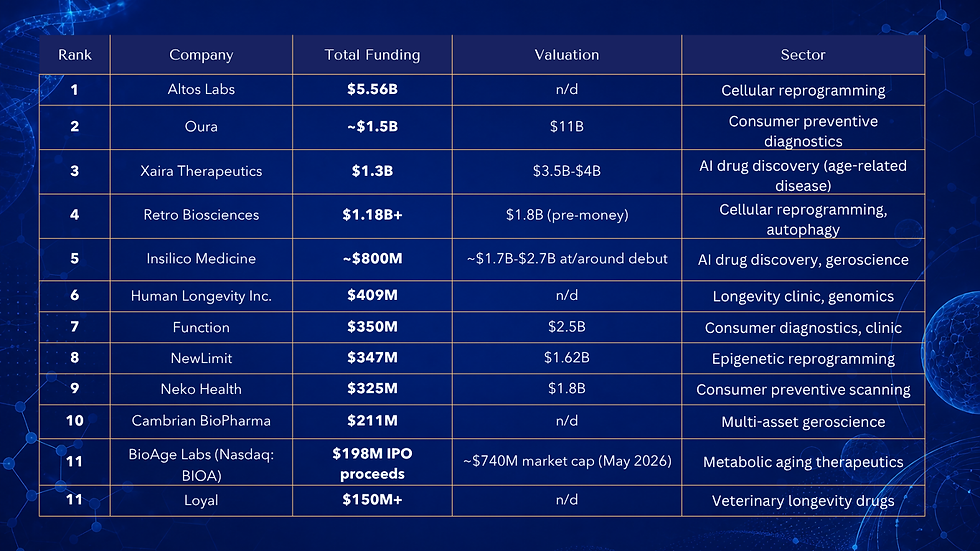
The first observation is rotation. Altos remains first, while Insilico and Human Longevity have shifted to fifth and sixth, with Oura, Xaira, and Retro entering or moving ahead of them. The second observation is structural: Oura, Neko, and Function are consumer diagnostics franchises, not therapeutics. The category has broadened.
Three Events That Reshaped Longevity Investing in 2025-2026
Three events in the last fifteen months explain most of the movement on the leaderboard.

Insilico Medicine listed on the Hong Kong Stock Exchange on 30 December 2025, raising approximately $293M in the largest Hong Kong biotech IPO of the year. The Hong Kong public tranche was oversubscribed by a factor of 1,427. Eli Lilly and Tencent both participated as cornerstone investors, the first time either had cornerstoned a biotech listing. The signal is that an aging-biology platform can now reach public market liquidity with credible institutional anchors. Insilico has featured at past LIC editions, and Garri Zmudze of LongeVC, one of the company's earliest backers, joins LIC 2026.
Eli Lilly invested directly in NewLimit in October 2025, alongside Duke Management Company and Section 32, in a $45M extension at a $1.62B valuation. This appears to be one of the first direct equity positions by a top-five pharmaceutical company in a cellular reprogramming asset. Combined with Novartis's collaboration with BioAge (up to $550M in milestones), the message from Big Pharma is consistent: the longevity stack is now being engaged at the balance sheet level. The shift from licensing to equity participation is a thread LIC 2026 examines directly.
Life Biosciences announced on 28 January 2026 that it had received FDA IND clearance for ER-100, the first cellular rejuvenation therapy using epigenetic reprogramming cleared to enter human clinical trials. Three weeks later, on 18 February 2026, FDA Commissioner Marty Makary and CBER Director Vinay Prasad outlined the single-pivotal-trial pathway as a new default standard for drug approval. The development economics for some longevity-relevant therapeutic programs may be shifting.
Why Cellular Reprogramming Dominates Longevity Capital
Four companies on the leaderboard pursue partial cellular reprogramming or epigenetic rejuvenation: Altos Labs, Retro Biosciences, NewLimit, and Life Biosciences. Together, by New Market Pitch's longevity tracker methodology, they have absorbed approximately $4.7B - around 60% of disclosed longevity sector funding tracked between 2022 and 2025. This is not diversification. This is concentration.
![[GRAPHIC 3] This is what conviction capital looks like in longevity. LIC 2025 investor intelligence shows a community that has moved well past exploration - building structured, multi-position portfolios with the same deliberation normally reserved for private equity or real estate.](https://static.wixstatic.com/media/6b212a_e15c352d69cd4a709d86750c343df09d~mv2.png/v1/fill/w_980,h_551,al_c,q_90,usm_0.66_1.00_0.01,enc_avif,quality_auto/6b212a_e15c352d69cd4a709d86750c343df09d~mv2.png)
Altos Labs remains the anchor at $5.56B cumulative. The May 2025 acquisition of Dorian Therapeutics and the company's reported preparation for clinical translation indicate the platform is moving from preclinical research toward potential first-in-human studies. Dr. Steve Horvath, whose epigenetic clock work underpins much of the science Altos is built on, joins LIC 2026 in Gstaad.
Retro Biosciences moved from a $180M seed in 2022 to a $1B Series A in January 2025, with Sam Altman, Sandro Salsano, and a group of family offices and sovereign wealth funds participating. STAT reported on 22 May 2026 that the latest fundraise valued the company at $1.8B pre-money. The Phase 1 Alzheimer's trial for RTR-242 commenced in August 2025 with no dose-limiting toxicities reported. Retro featured at LIC 2025 in Gstaad.
NewLimit doubled its cumulative funding in less than twelve months, from approximately $130M to $347M. The structural significance is the Lilly equity check.
Life Biosciences does not appear on the funding leaderboard at scale (cumulative funding sits around $100M), but the ER-100 IND clearance announced on 28 January 2026 - the first cellular rejuvenation therapy using epigenetic reprogramming cleared for human trials - converts the cellular reprogramming thesis from a platform bet into a clinical-asset bet. Michael Ringel, the company's COO, will present at LIC 2026 in September.
The combined cumulative funding across these four companies sits above $7B by aggregated disclosed and tracker-reported figures - representing a substantial share of the sector's total deployed capital across all other sub-categories combined.
The Rise of Consumer Longevity Diagnostics: Oura, Function, Neko
Oura has raised approximately $1.5B in cumulative funding, with a $900M Series E in October 2025 led by Fidelity Management & Research bringing the company's valuation to $11B. The company surpassed 5.5 million rings sold by September 2025 and is on track to reach $1B in annual sales while expanding profitability.
Function raised a $298M Series B in November 2025 at a $2.5B valuation, bringing cumulative funding to $350M. The company has reported strong subscriber growth and tens of millions of lab tests run since 2023. The May 2025 acquisition of Ezra integrated FDA-cleared full-body MRI screening into the membership at a $499 consumer price.
Neko Health closed a $260M Series B in January 2025 at a $1.8B valuation, bringing cumulative funding to $325M. Co-founded by Spotify CEO Daniel Ek, the company has built physical scanning centres in Stockholm, London and Manchester, with New York scheduled for 2026.
The collective signal is consistent. Consumers are paying for comprehensive longevity diagnostics before any FDA-approved anti-aging drug exists. The commercial layer is not waiting for the therapeutic pipeline to mature.

Big Pharma's Longevity Strategy: Selective Conviction
AbbVie terminated its 11-year partnership with Calico Life Sciences on 12 November 2025, laying off approximately 100 scientists. The collaboration began in 2014 with an initial commitment of up to $1.5B and was expanded in 2018 and 2021 to a potential value of $3.5B. At the same time, Eli Lilly cornerstoned the Insilico IPO and invested directly in NewLimit, while Novartis entered a multi-year collaboration with BioAge worth up to approximately $550M.
The pattern signals selective conviction. Big Pharma is choosing platform companies with credible clinical paths and exiting those that lack them. This is more useful for the category long-term than a broader rising-tide of pharmaceutical engagement, because it establishes that longevity assets are now being assessed against the same diligence frameworks as any other therapeutic platform.

Five Patterns Shaping Longevity Investment in 2026
1. Concentration is the strategy, not a risk. Top 10 deals captured between 83% and 96% of annual longevity capital each year from 2022 through 2025. In 2025, Retro's $1B round alone represented 58% of total category funding. Broad-basket exposure fails to reproduce category returns.
2. Cellular reprogramming is the spine. Approximately 60% of all longevity capital across the last four years has gone to four companies. Three of them sit in the top seven. Allocators building deliberate longevity exposure need a position on this thesis or a deliberate reason not to.
3. Consumer diagnostics is a separable thesis with its own exit path. Oura, Function and Neko have built unicorn-and-multi-unicorn valuations on consumer revenue. For allocators with consumer or healthtech experience, this layer is investable on different metrics than therapeutics.
4. Pharma engagement is shifting from licensing toward equity exposure. Lilly's NewLimit and Insilico positions, plus Lilly and Novartis's BioAge collaborations, suggest a structural move from licensing-only engagement toward balance sheet exposure. This pattern could compress the timeline to first acquisition exits if it continues.
5. Public-market access is now plausible. Insilico's HKEX IPO, BioAge's Nasdaq listing, and Lilly and Tencent's cornerstone participation together demonstrate that public market access for aging-biology platforms is now a realistic exit path, not a theoretical one.
The 2026 ranking captures a category in transition - from venture-stage experimentation into institutional positioning, from platform thesis into clinical asset, from pharma-curious into pharma-equity.
Where Longevity Investors Meet: LIC 2026
The investors who first underwrote Retro at $180M, Insilico at sub-$500M, or NewLimit at sub-$150M are now sitting on multiples that the public markets will not produce for another full investment cycle.
The conversation about how to build conviction in this category at this stage - which sub-thesis, which time horizon, which structures - is the conversation that the Longevity Investors Conference is designed for. The seventh edition takes place in Gstaad from 14 to 17 September 2026, bringing together the scientists, operators, and early investors building the companies on this leaderboard alongside Dr. Aubrey de Grey, Dr. Nir Barzilai, Matt Cooper (Exceptional Ventures), Dave Asprey, and others.
Applications are open at longevityinvestors.ch/lic-2026. Early Bird pricing closes on 31 May.
References
[2] STAT News. Longevity startup Retro Biosciences says latest fundraising values it at $1.8 billion. 22 May 2026.
[7] Longevity.Technology. Insilico debuts on HK Stock Exchange, locking in more than $290m. 30 December 2025.
[12] NewLimit. NewLimit has raised an additional $45M from Lilly, Duke University and Section 32. October 2025.
[16] Medpath. Life Biosciences Receives FDA Clearance for First-Ever Cellular Rejuvenation Therapy Using Epigenetic Reprogramming. January 2026.
[18] Business Wire. Loyal Receives FDA Acceptance for Senior Dog Lifespan Extension. 26 February 2025.
[21] Crunchbase News. Longevity Startup Funding Sees Fewer Moonshots. November 2025. [22] Tracxn. Human Longevity Inc. Company Profile. 2026.


Comments