Longevity's Moonshots in 2026: The Breakthroughs, the Risks, and the Capital Behind Them

Cellular reprogramming reached its first patient, heritable embryo editing drew venture funding, and pharmaceutical capital moved into aging biology from Eli Lilly to Roche's Chugai. A clear-eyed look at longevity's moonshots in 2026: the breakthroughs, the risks, and who is paying for them.
The longevity story that reaches most people in 2026 is a reassuring one: sleep, exercise, a sensible supplement routine. That ground is real, but it is not where the consequential decisions are being made. Over the past year, the developments that moved the most capital, and raised the most difficult questions, were often the ones the field discusses carefully, or not at all. They run from the first human dosing of a cellular reprogramming therapy to startups researching heritable embryo editing. They are worth examining directly, with the evidence in front of us, because for investors the question is no longer whether longevity is real. It is how to tell a genuine breakthrough from an expensive one, and this past year produced both.
The Moonshot That Just Reached Its First Human Patient
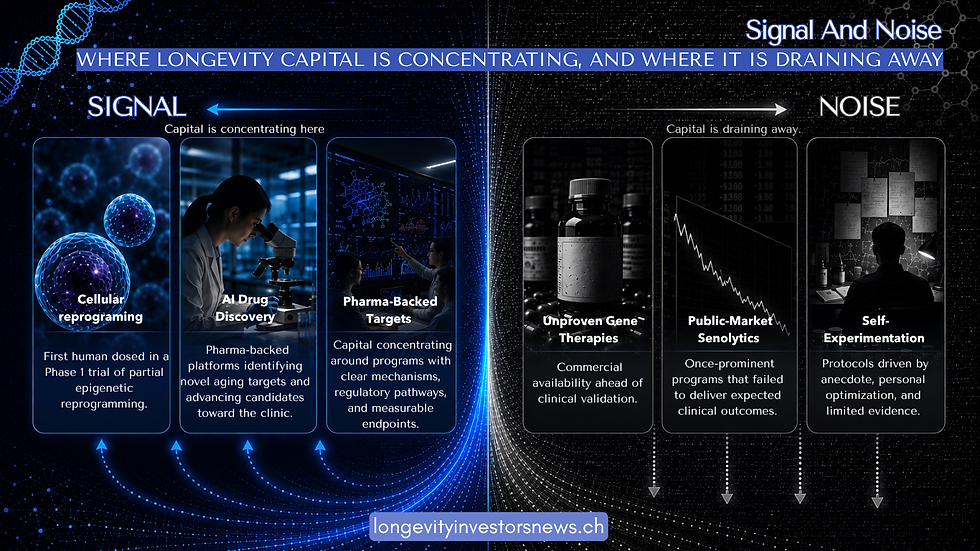
For a decade, partial cellular reprogramming was the field's signature moonshot and its signature slide. That changed on 9 June 2026, when Life Biosciences dosed the first human in a Phase 1 trial of ER-100, a therapy that switches on three of the Yamanaka factors, OCT4, SOX2 and KLF4, to reset aged cells toward a younger pattern of gene expression. The trial targets optic neuropathies, including open-angle glaucoma, where the therapy can be delivered locally and its effect measured directly. It is the first time a participant has been treated in a trial of partial epigenetic reprogramming.
This is not a distant name to the LIC community. Life Biosciences was co-founded by David Sinclair, a familiar voice from the LIC stage, and its chief operating officer Michael Ringel joins LIC 2026 to take investors inside the trial. The distinction that matters is simple: this is a regulated, endpoint-driven readout, not a statement about what might one day be possible.

Why the Smart Money Stopped Waiting
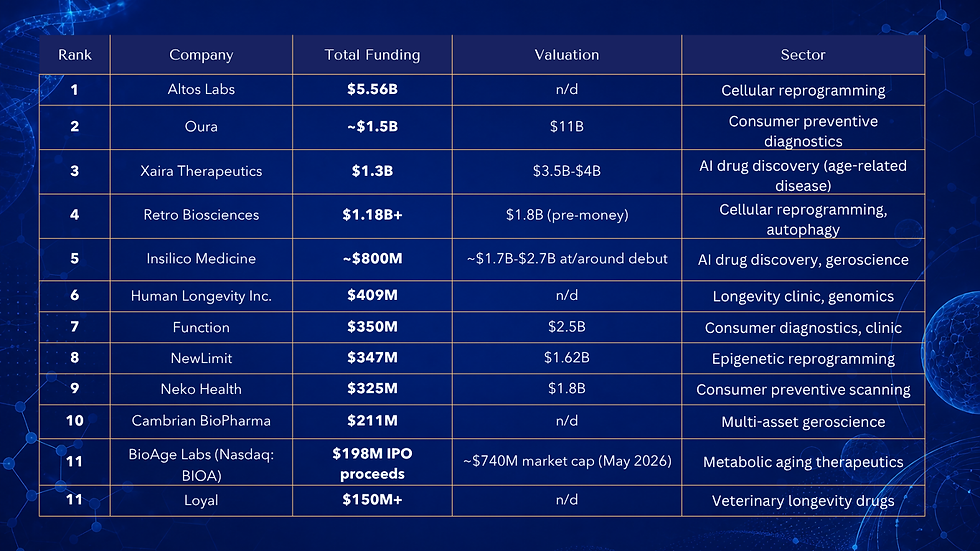
The money has moved even faster than the clinic. In June 2026, NewLimit, the reprogramming company co-founded by Coinbase's Brian Armstrong, closed a $435 million Series C led by Founders Fund at a $3.1 billion post-money valuation, more than tripled from a year earlier. Retro Biosciences, which counts $180 million of Sam Altman's own money, has been reported at a valuation near $1.8 billion, and its CEO Joe Betts-LaCroix has presented at LIC.
The clearest signal for institutional allocators came at the end of 2025, when Insilico Medicine, founded by LIC alumnus Alex Zhavoronkov, completed the largest Hong Kong biotech IPO of the year, raising HKD 2.277 billion (about US$290 million). The cornerstone list is the real story: Eli Lilly and Tencent took positions, their first ever as cornerstone investors in a biotechnology company, and the public tranche was oversubscribed more than 1,400 times. Nor is the pharmaceutical interest limited to one company. In July 2025, Roche's Chugai agreed to pay up to $250 million to Gero, a Singapore-based AI-aging startup that recently added LIC speaker Dr. Brian Kennedy to its board, for the rights to develop therapies against the aging-related targets its platform identifies. For institutional allocators, a pharmaceutical cornerstone in a major biotech IPO and a separate nine-figure collaboration on aging targets, both inside a year, are the kind of signals that move a category from speculative toward investable. By Longevity.Technology's count, the sector drew around $8.49 billion across 331 deals in 2024, and that capital is now concentrating into the programs that can show a mechanism and a regulated endpoint.

When Editing Human Embryos Becomes a Startup
Alongside that regulated progress sits a harder set of developments, the ones the field tends to mention quietly, if at all. They are no less real, and for an investor they are no less important to understand. In 2025, editing the human germline stopped being rogue science and became an incorporated company. Preventive, founded by gene-editing scientist Lucas Harrington and registered in Delaware, raised $30 million to research heritable embryo editing: modifying the DNA of embryos in a way that would then pass to every future generation. Leading CRISPR scientists reacted with something closer to grief than excitement, and a US senator has already asked federal health authorities to step in. The Wall Street Journal reported that the company has explored doing the work in the United Arab Emirates, where the rules are looser.
The continuity worth noting is on the cap table. Preventive is backed by Sam Altman and Brian Armstrong, the same names behind Retro and NewLimit. The capital funding the regulated clinical frontier and the capital funding the embryo frontier are, in places, the same capital. That is precisely why the topic belongs in an investor conversation rather than a footnote. At LIC 2026 it is on the agenda directly: the conference's moonshot session takes on embryo selection, and Jonathan Anomaly, a thinker who examines the case for genetic enhancement, is among the confirmed voices.
The Unregulated Edge, and What It Costs
The frontier also carries a cost, and the data on it is sobering. Minicircle, an operation running out of a private economic zone in Honduras, markets a reversible follistatin gene therapy at around $25,000, and Bryan Johnson has taken it and published his results. The therapy remains clinically unproven, with no peer-reviewed evidence of a longevity benefit. At a longevity festival in Las Vegas in July 2025, two women were hospitalised after peptide injections from an unlicensed booth, and Nevada regulators later issued fines. For an investor, that is not just a difficult headline. It is the regulatory perimeter forming in real time around the unregulated end of the market, and a preview of the compliance risk that comes with the territory.

Why Cryonics Is Raising Real Money
Even cryonics, long the field's most ridiculed idea, now has a balance sheet. Berlin's Tomorrow.Bio, a recurring LIC partner whose founder Dr. Emil Kendziorra has spoken from the LIC stage, raised €5 million in 2025 to expand into the United States. It reports more than 800 signed preservation contracts and a total contract value above €160 million, with whole-body preservation priced around $220,000. A contract book of that size is built on demand, not belief alone. Wild is no longer the same as unfunded.
The Failures That Tell You the Most
What keeps all of this credible is that the field's most prominent bets keep failing in public. Unity Biotechnology, once the great senolytics hope, was dissolved in 2025 after disappointing clinical results. Bryan Johnson, the most documented self-experimenter alive, dropped rapamycin in 2024 after deciding the side effects were not worth it. And the science rests on a foundation it cannot take for granted: Washington's 2026 budget request proposed cutting NIH funding by roughly 40 percent, underscoring how exposed the public-research pipeline remains. The honest reading of 2026 is not that everything works. It is that the gap between what works and what merely sells has rarely been wider, or more useful to the investors who can tell the two apart.
The Price of Being Early
The frontier is also, for now, priced for a narrow market, and that pricing is itself worth reading. Early access carries early-market costs: plasma-exchange sessions run into the thousands per visit, the offshore gene therapy around twenty-five thousand, a cryonics arrangement into the low six figures, and the most public longevity protocol on earth costs its owner a reported $2 million a year. Whether that is a temporary feature of an early market or the permanent shape of the industry is one of the more honest questions an investor in this space can ask, and one of the few that will still matter in a decade.

Where Capital and Science Sit Down Together
That is the real state of longevity in 2026: genuine clinical firsts and pharma-grade capital on one side, embryo editing and gray-market biology on the other, and a widening distance between them. The investors and scientists deciding which side to fund gather each September in Gstaad at the Longevity Investors Conference, where these questions are examined in full, with the evidence on the table, among the people actually funding the science. The capital behind it is not slowing down. Neither are the questions.
References
[1] Life Biosciences. First Patient Dosed in Phase 1 Trial of ER-100 for Optic Neuropathies. June 9, 2026. https://www.lifebiosciences.com/life-biosciences-announces-first-patient-dosed-in-phase-1-trial-of-er-100-for-optic-neuropathies/
[2] Fierce Biotech. NewLimit raises $435M Series C, valuation hits $3.1B, more than triple its mark a year earlier following its $130M Series B in May 2025. June 2026. https://finance.yahoo.com/sectors/healthcare/articles/newlimit-raises-435m-series-c-145642833.html
[3] TechCrunch. Retro Biosciences, backed by Sam Altman, is raising $1 billion to extend human lifespan. January 2025. https://techcrunch.com/2025/01/24/retro-biosciences-backed-by-sam-altman-is-raising-1-billion-to-extend-human-lifespan/
[4] Insilico Medicine. Insilico Medicine Lists on Hong Kong Stock Exchange, 2025's Largest Hong Kong Biotech IPO. December 30, 2025. https://www.prnewswire.com/news-releases/insilico-medicine-lists-on-hong-kong-stock-exchange-showing-ai-drug-discovery-momentum-with-2025s-largest-hong-kong-biotech-ipo-302650606.html
[5] Chugai Pharmaceutical. Chugai and Gero Enter into Joint Research and License Agreement to Develop Novel Therapies for Age-Related Diseases. July 7, 2025. https://www.chugai-pharm.co.jp/english/news/detail/20250707160000_1156.html
[6] Longevity.Technology. 2024 Annual Longevity Investment Report: total financing of $8.49 billion across 331 deals. May 13, 2025. https://www.prnewswire.com/news-releases/longevity-investment-more-than-doubled-to-8-5bn-in-2024--302453871.html
[7] MIT Technology Review. Here's the latest company planning for gene-edited babies. October 31, 2025. https://www.technologyreview.com/2025/10/31/1127461/heres-the-latest-company-planning-for-gene-edited-babies/
[8] MIT Technology Review. This company is developing gene therapies for muscle growth, erectile dysfunction, and "radical longevity". December 22, 2025. https://www.technologyreview.com/2025/12/22/1130288/gene-therapies-muscle-growth-erectile-dysfunction-radical-longevity/
[9] ProPublica. Nevada Issues Fines for Peptide Injections at RAADFest, Where Two Women Fell Ill. March 2026. https://www.propublica.org/article/raadfest-peptide-injections-nevada-fines
[10] EU-Startups. Europe's first cryonics lab Tomorrow.Bio eyes US expansion with EUR 5 million in fresh funding. May 2025. https://www.eu-startups.com/2025/05/cryo-now-heal-later-europes-first-cryonics-lab-tomorrow-bio-eyes-u-s-expansion-with-e5-million-in-fresh-funding/
[11] Investing.com. Unity Biotechnology stockholders approve company liquidation and dissolution plan. September 2025. https://www.investing.com/news/sec-filings/unity-biotechnology-stockholders-approve-company-liquidation-and-dissolution-plan-93CH-4247557
[12] Bryan Johnson / Blueprint. I stopped taking rapamycin. January 2025. https://blueprint.bryanjohnson.com/blogs/news/i-stopped-taking-rapamycin
[13] Science (AAAS). Trump proposes massive NIH budget cut and reorganization. May 2025. https://www.science.org/content/article/trump-proposes-massive-nih-budget-cut-and-reorganization


soicauxsmb24.com tối qua mình vào đọc đúng nghĩa “lướt cho đỡ buồn tay”, không kỳ vọng gì nhiều ngoài xem chữ nghĩa có dễ theo không. Trang này chia theo ngày nhìn khá thẳng thắn, mình thấy ngay bài soi cầu MB ngày 3 9 2026 nằm rõ trên đầu nên khỏi phải mò, kéo xuống là nội dung hiện ra liền, kiểu ai hay đọc nhanh sẽ thích. Có mấy đoạn họ nói dựa vào kết quả quay trước để lọc cặp số gợi ý, đọc qua là hiểu ý chứ không cần ngồi đoán họ đang làm gì. Menu đặt đúng chỗ nên chuyển qua lại nhẹ nhàng. Nói chung không hoa lá. Mình để ý phần “Dự…
tỷ lệ kèo mình thấy mọi người nói hoài nên cũng bấm vào nghía thử cho biết. Mình không rảnh ngồi đọc kỹ từng mục đâu, chủ yếu xem họ làm giao diện có dễ nhìn không thôi. Vào cái là thấy trang chia nội dung thành từng khối tách bạch, nhìn lướt vẫn biết phần nào ra phần đó, không bị dồn chữ khiến rối mắt. Mình thích nhất là mấy bảng dạng cột trình bày gọn, kéo xuống vẫn theo được dòng, không phải căng mắt dò. Với lại cái menu để chuyển qua lại đặt khá lộ, bấm một cái là qua trang khác nhanh, đỡ phải mò nhiều bước. Nói chung cảm giác dùng khá nhẹ…
Đọc xong bài này mình thấy đúng kiểu đề tài nghe lạ tai mà càng đọc càng bị hút. Trước giờ mình chỉ biết sơ sơ về rồng qua vài mẩu chuyện truyền miệng, nhưng khi để ý kỹ mới nhận ra mỗi hình ảnh lại gắn với một tầng nghĩa riêng, lúc thì quyền uy, lúc thì che chở, lúc lại tượng trưng cho vận may. Có thời gian mình còn thích sưu tầm tranh và mấy món đồ nhỏ để trên bàn, nhìn vào thấy có động lực hơn, như tự nhắc bản thân phải cố gắng. Đoạn nhắc tới Rồng bạch kim làm mình nghĩ đến cảm giác vừa cứng cáp vừa trong trẻo, không cần phô…