Spotting Real Aging Science: What October's GLP-1 Aging Clock Data Means for Longevity Investors

Lilly and Novo report that their weight-loss drugs improve aging clock readings. We put the findings, and October's other big longevity results, through the test the LIC 2026 Masterclass gave investors in Gstaad.
"We managed to reverse the biological age with this drug by five years." At LIC 2026, Prof. Dr. Evelyne Yehudit Bischof, MD, MPH, put that pitch-deck line to Dr. Steve Horvath and Dr. Collin Y. Ewald and asked what they would check first.
Less than three weeks later, two of the biggest names in pharma made a version of that claim on stage. Eli Lilly and Novo Nordisk reported that patients on their GLP-1 drugs aged more slowly than patients on placebo, as measured by molecular aging clocks.
So we ran it, and October's other headline results, through the Masterclass test. What passes matters well beyond two drug franchises. The tools for testing longevity's hardest question, whether a drug slows aging at all, are getting more serious.
The Masterclass test
The session, How to Tell the Difference: Spotting Real Aging Science, had one aim: to give investors the criteria scientists actually use to separate rigorous aging science from a compelling pitch deck.
Dr. Steve Horvath, the scientist who created the epigenetic clock, starts every "we reversed biological age" claim with the three Cs:
Control group. Compared to what? Was it a randomized controlled trial?
Context. Was it done in cells in a dish, in a mouse, in the right cell type or population?
Clock. Which clock was used, and do several clocks show the same result? To be truly convinced, he wants the raw data, not a single headline number.
Dr. Collin Y. Ewald, who works inside Novartis's diseases of aging and regenerative medicine unit, added the checks a drug developer makes:
Repeat it. The best test is to run the experiment again, because, in his words, "a lot of things just don't hold up."
Check delivery. A molecule that cannot reach its target tissue will not work, however good the biology looks.
Read the patent. Make sure the chemistry will hold up as an asset.
Horvath closed with one rule for any pitch deck: go straight to the milestones. Are they specific, can they fail, and are they ambitious enough?

What Lilly and Novo actually showed
Both companies presented at the Aging Research and Drug Discovery meeting in Boston in early October. An aging clock is a test that estimates biological age from molecular patterns in the body, such as chemical tags on DNA or the levels of certain blood proteins.
Novo Nordisk (semaglutide, sold as Ozempic and Wegovy): blood from 10,052 trial participants, half on the drug and half on placebo, measured with protein-based clocks. Overall, treated patients came out around two to three years biologically younger, with up to four years on a clock that reads heart proteins.
Eli Lilly (tirzepatide, sold as Mounjaro and Zepbound): a smaller study using DNA-based clocks. Lilly's head of aging research said all the clocks pointed the same way, though, according to The Washington Times, the analysis did not include a placebo group.
Horvath was impressed. He told MIT Technology Review: "Two years is a pretty strong effect, in my book." He said the data could be evidence that GLP-1s are geroprotectors, drugs that slow or even reverse biological aging.
Several caveats belong next to the headline. Without a placebo group, Lilly's result cannot separate the drug's effect from the effect of weight loss itself. The patients were overweight or diabetic, so the results say nothing yet about healthy people. The findings were presented at a conference and are not yet peer-reviewed. And Novo's own scientists said the data does not establish biological rejuvenation. A younger clock reading is a signal, not proof that aging itself has slowed.
The commercial stakes are large either way. Tirzepatide earned Lilly more than $36 billion last year, and MIT Technology Review reports it topped global drug sales. Lilly now has a vice president dedicated to aging research. Big Pharma is no longer watching longevity from the sidelines.

Running October's results through the test
The GLP-1 data did not arrive alone. Three other results since early September point the same way:
Insilico's rentosertib. Nature Biotechnology published an analysis of a Phase 2a trial of this AI-designed lung fibrosis drug. Across 42 patients, six independently developed protein clocks all showed lower predicted biological age on the drug than on placebo, roughly 2.7 to 3.5 years at week four in the 30 mg twice-daily arm, according to reporting on the paper. Insilico reports that the dose that most improved lung function was not the one that most moved the clocks. That raises the question of whether the two effects are separate, though a 42-patient study cannot settle it. The drug is now in Phase 3.
Senolytics. Nature Metabolism published a Phase 2, placebo-controlled trial of dasatinib plus quercetin, a drug pair that clears senescent cells (damaged "zombie" cells that stop dividing and inflame the tissue around them). In 31 patients with fibrotic MASH, a serious form of fatty liver disease, fibrosis improved on liver biopsy, the trial's main goal, in 47% on treatment against 7% on placebo, a statistically significant difference despite the small size. That is a liver result, not an aging clock reading.
Reprogramming. On 8 October, Life Biosciences reported first results for ER-100, the first partial epigenetic reprogramming therapy to receive FDA clearance to begin human trials. It was well tolerated in all three glaucoma patients through day 56, and two of three showed improved visual field scores. These are early safety and exploratory observations, not evidence that reprogramming has reversed aging in humans.
Here is how the five results stack up against the Masterclass criteria:

Novo's data is strongest on the first and third Cs: a large placebo group and agreement across several clocks. The weak C is context. Every clock result here comes from patients, not healthy people. Vadim Gladyshev of Harvard, who helped Novo with its measurements, made the same distinction. Horvath, quoted on the GLP-1 data, said he is not ready to take the drugs himself until there is evidence in lean people.
Ewald's first check, repeat it, has fresh support too. A study in Aging Cell on 8 October re-tested earlier trials that had reported a younger biological age on a single clock. When the researchers added other clocks, none of them confirmed the original result. Multi-clock agreement, as in Novo's and Insilico's data, is what separates a signal from noise.
Why passing the test matters: longevity's endpoint problem
Every drug trial needs an endpoint, the measurable result that tells regulators whether the drug worked. For aging, the natural endpoint is a longer, healthier life, and no company can run a trial for twenty years to show it.
The FDA and other major regulators do not treat aging itself as a disease, so there is no approved way to prove an aging drug works. The industry has worked around this in three ways:
Pick a disease and treat aging as the mechanism. Life Biosciences tests its rejuvenation therapy in glaucoma, Insilico in lung fibrosis.
Go through veterinary medicine first. Loyal's dog longevity drug follows a separate regulatory path with shorter-lived patients.
Sell to consumers instead of regulators. Clinics, diagnostics and supplements, where the evidence bar is lower and so is the defensibility.

Each route works, but each adds cost, time or risk. A validated aging biomarker, one regulators accept as a stand-in for healthy lifespan, could let trials show results far sooner. Getting there means proving that a clock reliably predicts real health and survival outcomes, which is itself a long scientific and regulatory process. In medicine this is called a surrogate endpoint, and it is what cholesterol did for heart drugs.
That is why the GLP-1 data matters beyond Lilly and Novo. Until now, clock studies were mostly small, uncontrolled or built on interventions with unclear benefits. This time, clocks moved in the right direction on drugs already known to cut heart attacks, protect kidneys and reduce deaths. As one former clock researcher told MIT Technology Review, the clock field had wanted this kind of study for a decade.
The US government is already building the regulatory side. Its health research agency ARPA-H runs a $144 million, five-year programme called PROSPR to develop medicines that prevent age-related decline. One of its trials, VITAL-H, plans to test semaglutide, rapamycin and dapagliflozin against placebo in 726 healthy adults aged 60 to 65 over three years, and aims to set a regulatory-grade framework for preventive aging drugs.
The funding map the endpoint problem has drawn
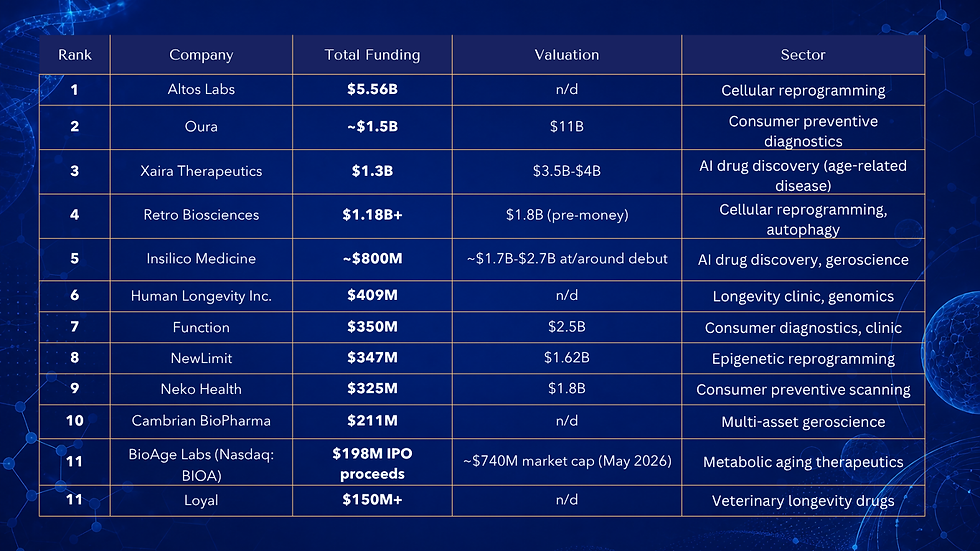
The endpoint problem is not only scientific. It shapes which companies can raise capital, and how much. New Market Pitch, which tracks equity rounds in pure-play longevity biotech, makes the pattern plain. In Q2 2026, two companies took 91.9% of disclosed longevity biotech funding: NewLimit's $435 million Series C and Life Biosciences' $80 million round, out of a quarter total of $560.4 million.

Take out the rounds above $50 million and the picture changes. From Q3 2025 to Q2 2026, smaller rounds stayed in a narrow band of about $45 to $77 million per quarter, while headline totals swung with one or two large deals. Q2 2026 had no first-time financings at all, and the median age of funded companies rose to about eight years.
The pattern is consistent with investors paying for concrete clinical or regulatory milestones, which mostly established companies can show, although funding data alone cannot reveal the reasons behind each deal. Younger companies with good science but no near-term human data struggle to raise the $20 to $50 million rounds that would carry them there. A credible aging biomarker is exactly the kind of milestone those companies currently lack.
What it means for capital allocation
If aging biomarkers do become accepted endpoints, the effect would reach far beyond two drug franchises. Five implications stand out for investors.
The dual-purpose model is the financeable route today. Treat a disease, measure aging alongside it. Insilico says most of its 40-plus programmes now target both aging and disease. Companies that add aging biomarkers to their current trials are building evidence for a future regulatory pathway without running a separate clinical programme. It is worth asking every portfolio company whether they do.
The middle of the market may be where the asymmetry sits. Today, young companies cannot reach the clinic because there is no fast way to prove an aging effect. If that changes, the $20 to $50 million rounds that are currently scarce could become fundable, and early positions taken before validation would carry the most upside. That remains a bet on regulation, not a certainty.
Measurement infrastructure gains value either way. Proteomic platforms, clock developers and long-running patient datasets are the tools every trial would need. Novo's study ran on more than 10,000 blood samples. This is a picks-and-shovels position that does not depend on any single drug working.
Big Pharma is building the exit route. Lilly invested directly in NewLimit in 2025 and has an executive dedicated to aging research. Novo is publishing aging data on its own blockbuster. That could widen partnership and exit options for companies with convincing clinical evidence, though in-house aging research does not guarantee acquisitions.
Diligence gets more technical, not less. As clock results multiply, so will single-clock claims in pitch decks. The Masterclass checks, the three Cs, independent replication, delivery and falsifiable milestones, are a practical first screen before any deeper review.
The bottom line
For a decade, longevity investors have backed companies that could not prove their core claim within a normal fund life. October's results do not solve that problem. They do show aging clocks being measured inside large drug programmes with real clinical outcomes, alongside a government programme working on the regulatory path. Whether clocks become regulatory-grade endpoints remains an open question.
The companies best placed are those already generating the evidence regulators will eventually ask for. The investors best placed are those who can tell a three-C result from a single-clock headline.
The full Masterclass, How to Tell the Difference: Spotting Real Aging Science, with Dr. Steve Horvath, Dr. Collin Y. Ewald and Prof. Dr. Evelyne Yehudit Bischof, MD, MPH, is on our YouTube channel: watch the session.
The conversation continues at the Longevity Investors Lunch in Davos on 19 January 2027, during WEF week. Participation is application-only, with applications opening on 30 October. Details at longevityinvestors.ch/davos-2027.
References
MIT Technology Review, Weight-loss drugs show signs of slowing biological aging, say drugmakers, 6 October 2026
The Washington Times, The Ozempic fountain of youth? Doctors wary of GLP-1 drugs' anti-aging claims, 23 October 2026
Texas Public Radio, San Antonio's Barshop Institute to test three approved drugs for slowing aging, 17 March 2026
FOX San Antonio, San Antonio leads national research effort on aging (ARPA-H PROSPR)
New Market Pitch, Longevity Biotech Funding: A Quarter-by-Quarter Analysis, updated 6 October 2026
Unite.AI, Proteomic aging clocks track biological age reversal in rentosertib trial, September 2026 (on the Nature Biotechnology paper, 7 September 2026)
Nature Metabolism, Senolytics dasatinib and quercetin in metabolic dysfunction-associated steatohepatitis: a proof-of-principle randomized, controlled trial, October 2026 (summary)
Life Biosciences, First-in-human data from ongoing Phase 1 trial of ER-100, 8 October 2026
Aging Cell, When to Trust Epigenetic Clocks: Avoiding False Positives in Aging Interventions, 8 October 2026
News-Medical, AI-designed drug candidate reverses biological age in clinical study, 7 September 2026
Longevity Investors, How to Tell the Difference: Spotting Real Aging Science, LIC 2026 Masterclass, September 2026


Comments